
Affectionately known as ‘Chema’ by his friends and family, José María Olazábal has had an illustrious career both on-and-off the golf course, and is gaining global recognition for his work as a golf course designer.
With two Masters victories to his credit, Olazábal was captain to one of the most incredible final days in Ryder Cup and golf history, when in 2012, his team staged one of the greatest ever final-day comebacks at Medinah Country Club, Illinois.
Facing a 10-6 deficit, Europe won 8½ points from 12 singles matches on Sunday to win the Cup by 14½ to 13½ , a victory Olazábal later dedicated to his long-term friend, and mentor, Seve Ballesteros who had passed away the previous year.
Olazábal was born in Fuenterrabia, a town in the Basque autonomous region of Spain, and as he explains, has his parents to thank for introducing him to golf: “We lived on a golf course and I was born the day after the golf course opened.
“My family worked in different areas at the golf club and my mother literally put the flags into the first nine holes the day before my birth.”
Growing up on a golf course clearly benefited the young Spaniard, and he burst onto the golf scene in 1984 as a junior, winning the British Amateur Championship aged 18.
“I had a successful amateur career as a junior golfer and turned professional right after my 18th birthday,” recalls Olazábal. “I was able to win the Qualifying School and to move right onto the European Tour in my very first season as a professional and went on to win a tournament on Tour as a rookie.
“That was the European Masters in Crans Montana, Switzerland.”
He made his debut in the Ryder Cup in 1987 at the age of 21 and played a vital role, notably in partnership with Ballesteros, and following a string of European Tour victories, won his first Major in 1994.
“I had an amazing season in 1994 with four victories on the US and European Tour and it was certainly a crucial time in my career because I won my first Major title that year [The Masters at Augusta].”
However, later that year, the recurring pains in his feet began to intensify, and 12 months later, Olazábal was diagnosed with rheumatoid polyarthritis.
Throughout 1996, the pains grew so intense that he was sometimes reduced to crawling around his house, but in the autumn of 1996, Olazábal visited Dr. Hans-Wilhelm Mueller-Wohlfahrt, in Munich, and began an entirely fresh course of treatment.
Remarkably, by February 1997 he was playing in the Dubai Desert Classic, finishing twelfth, and two years later, won his second Masters, an achievement he ranks as his best ever.
“My Masters victory in 1999 was even more special to me because of my personal situation. I had been unable to play golf for around two years due to my health, and fought hard to come back to play professionally. To then come out on top as the Masters champion was in my own view my biggest achievement as a player.”
It’s evident from talking with Olazábal that Augusta National holds a very special place in his heart, and when asked what changes, if any, he would make to the layout, he emphatically says: “Absolutely nothing. Don’t change perfection.”
And perhaps it is this quest for perfection that led Olazábal into his first design venture in his native country as he explains: “I got started in my early twenties with my first design co-operations at La Sella Golf Club and Barcelona Golf.
“It all became more international in 2000 when I set up Olazabal Design together with my business partners Sergio Gomez and Matthias Nemes and we then started building up our own team. Today it has developed into what you could call a boutique design studio.
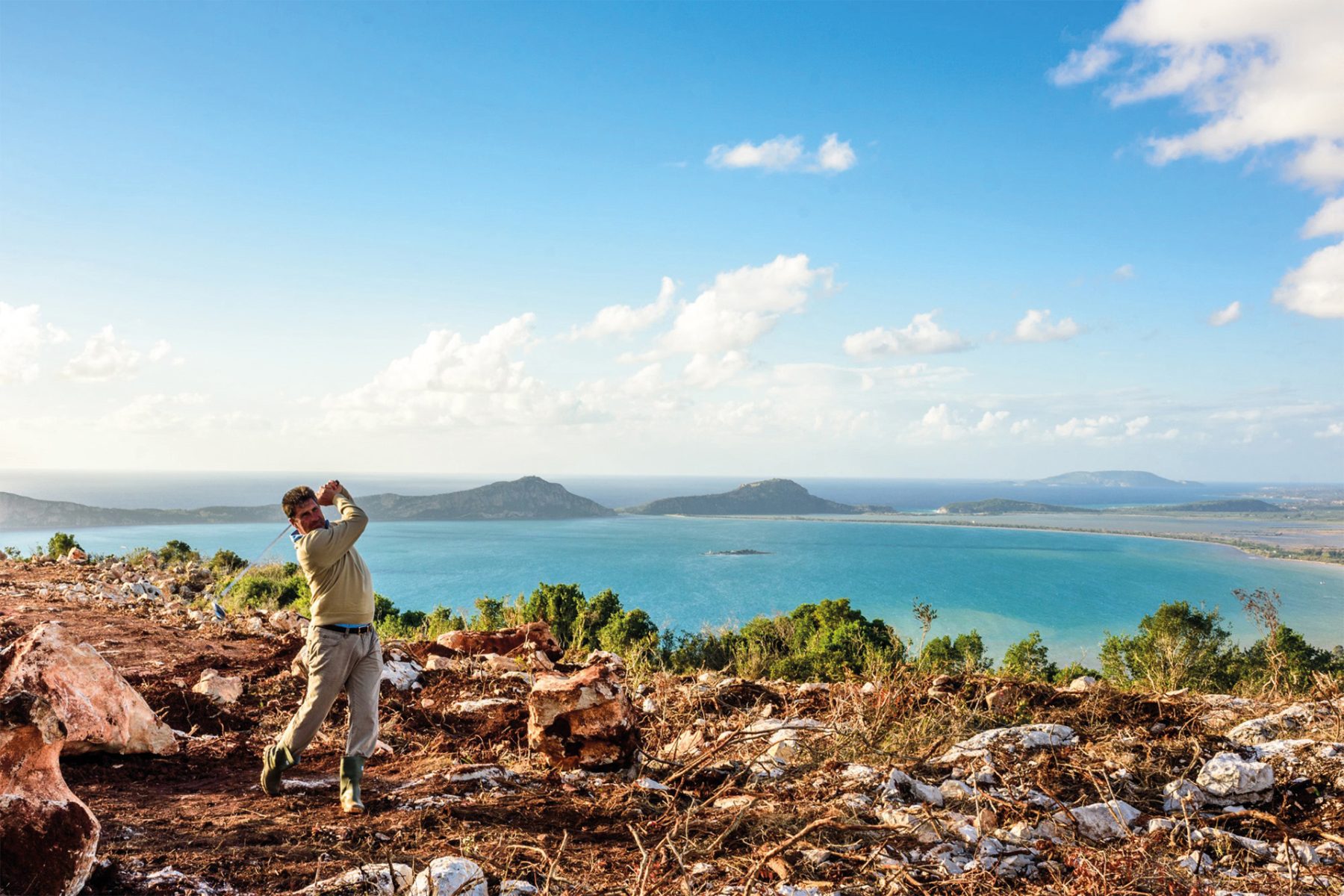
“We are small but we have been quite privileged to receive [some] spectacular design opportunities. We look at it as a team effort which I very much enjoy and I certainly plan to continue dedicating time to my golf designs.
“Our largest project currently is at the spectacular Costa Navarino in Greece where we have two new 18-hole courses under construction. Additionally, we are keeping busy with new designs or renovation works in Vietnam, the Middle East, Italy and Spain.
“The next one about to break ground is a modernisation of a 9-hole course at Club de Campo in Madrid which was originally designed by my late friend Seve Ballesteros over 25 years ago. We consider ourselves fortunate; each of the projects has its own personality and special characteristics which makes it so exciting.”
When quizzed about some of his best work, Olazábal says: “That is a tough one, but let me highlight Real Sevilla Golf Club and Education City Golf Club. Real Sevilla is a gem; it has been the host venue of many top tournaments and has always received a lot of praise from the pros as well as from the members and guests.
“Education City [in Qatar] is brand new and avant-garde in many respects. We worked on it for seven years; the course was just opened for play and we are happy about the positive feedback we have already received.”
But as much as Olazábal enjoys working with his design team and creating layouts for golfers all over the world to enjoy, how does it compare to winning on Tour? “Nothing beats the thrill of winning. But it is not only a tournament you can win, you also win or lose with a design project. In design, the thrill comes from the feedback of the golfers, be it from my peers, from members or from guests.”
And he returns to his admiration for Augusta National when asked who – if anyone – has influenced his design ethos.
“My love for Augusta is no secret but it would be unfair to single out one [architect], as there are so many wonderful designs to admire and learn from. I am surely influenced by all the travels as a professional player and by the opportunity to compete on so many of the world’s most sought after golf courses.
“What sticks [out] most is the diversity in golf course design combined with the beauty of the landscapes into which the courses were crafted. I would say that my inspiration comes as much from the golden age legends who gave us so many timeless classics as well as from our contemporary greats that created modern masterpieces across all continents.”
In 2009, aged 43, Olazábal was inducted into the World Golf Hall of Fame, so is ideally placed to share his thoughts on the challenges facing the game in the modern era, and also help shape that future by progressive golf course deign.
“I am convinced that the biggest challenge ahead for golf is to bring new people into the game. Golf can only be attractive long-term if we make it more fun, faster, and more affordable.”
And be assured that Olazábal will strive for perfection in his quest to ensure that both the game he adores, and the courses he designs, meet that criteria.