Those whose home courses have been frequently shut in the last year or so because of flooding – or risked drowning by playing in severe downpours – might not be surprised to hear Hans de Kort warn that golf is facing a serious problem with water.
What may cause surprise about the admonition from Aqua Aid Europe’s managing director is that it is focused on the cost, availability and quality of water rather than any abnormal meteorological conditions.
Aqua Aid Europe, a leading company in the field of sustainable water management, serves and supports sports turf industries, with 60-70 per cent of its turnover golf related. Courses that come under its care include Le Golf National in Paris, stage for the recent Olympic Games golf, Real Las Brisas, Real Golf de Pedreña – where Seve Ballesteros grew up – 2023 Solheim Cup venue Finca Cortesin, and Bernardus and Koninklijke Haagsche, the latter pair both rated among the top ten courses in his native country, the Netherlands.
Ten years on from single-handedly starting Aqua Aid Europe, de Kort sees golf clubs’ greenkeeping and management teams battling an economic crisis over successful irrigation of their courses. And those not combating it now will do so inside the next two years, he believes.
“Water in the past was never a problem. Every golf course had its well or its inside lake, where they could take water, or they had a mains from which they could take water whenever they wanted,” said the 60-year-old. “There was not so much of a budget issue because most of the wells were not really expensive, they didn’t need to pay the local government a lot of money for that.
“What we see happening now is water has become scarce, the cost of water is going up dramatically – people say water is going to be the gold of the future. The average 18-hole golf course takes about 250,000 cubic metres of water a year. Even at a cost of just €1 a cubic metre, that’s €250,000 that has to come from somewhere and that’s an additional cost, because in the past they didn’t have to pay for it.”
De Kort outlined the three main issues causing increased risk and concern. “There is the cost of the water itself and of electricity for the pump house etc. Then there is the availability.
“A course can face a ban or reduction put up by the local authorities. Most courses don’t even know how much water they use and that makes it even more complicated.
“Also, the quality of water in general is going down around the world. More salts and bicarbonates in the water going round have a negative effect on agronomic behaviour as these salts and bicarbonates are not used by the plant, but stay behind in the soil profile once the water is used. This causes an imbalance in the soil – and opens the door for diseases and plant stress.
“At some moment all of these three points will hit greenkeepers – so they had better be prepared by learning to reduce water consumption and reduce the potential issues in future.”
De Kort’s call to action might be seen as springing from a well of vested interest, given that Aqua Aid’s products can provide a minimum of 35-40 per cent water savings. But it is as much to do with his natural inclination, having been an engineer for most of his life, to search for a solution when encountering a problem.
“My father was a multi-discipline technician, so engineering sort of has always been in my blood. We built a model railway on the top floor of our house. I played there with the trains and so I made my first steps in mechanical and electronics engineering,” he said, adding with amusement: “I had my first 220V shock when I was 12 years old.
“While growing up, I moved more towards mopeds and speeding them up for friends. We had some sort of workshop in the yard, so you understand I grew up in the middle of all kinds of techniques.”
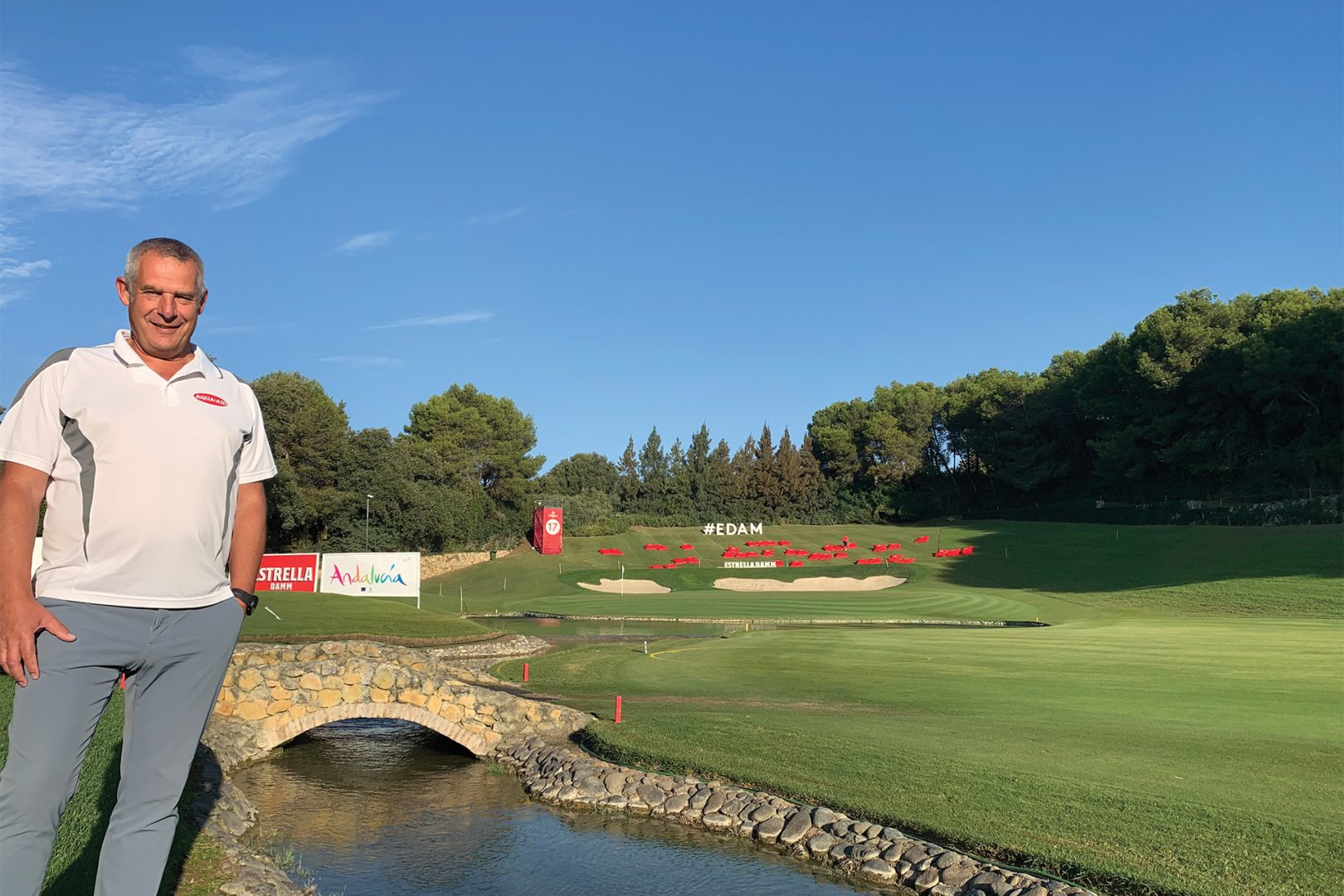
After working in the automotive industry for many years as program manager for Ford Europe, working on high-tech welding robotic lines, he took his first steps in the agricultural and turf maintenance industry with Imants BV in 2004, eventually becoming director/owner.
“I had a minority of shares and my partner had more shares, so I could push the boat, but I was not able to steer it,” he recalled. “I wanted to grow the company further and faster and my partner did not, and of course with his majority he had the last say.
“Then he asked me to slow down development – that’s where my heart is, to develop things. And that made me feel not really happy and my wife Monique said, ‘Well, you can do anything, Hans, so why don’t you stop this and just do something else?’”
The ‘something else’ was the creation of AquaAid Europe, which in a decade has grown from a one-man operation to a company dealing with distributors in 42 countries across Europe, the Middle East and northern Africa.
Underscoring its growing reputation is the fact that a couple of years ago two out of 18 football clubs in the German Bundesliga numbered among its clients. Now only two out of 18 do not.
Helping care for golf courses presents more of a challenge than football pitches because of their large acreage and variety of plant life.
One of Aqua Aid’s first steps towards helping reduce water consumption involves assessing the growing profile with a moisture meter establishing a soil’s field capacity – how much water a given volume of soil can retain until it starts to flush – and its wilting point – the moment when a plant growing in the soil is no longer able to extract water.
“Anywhere between fill capacity and wilting point is where the moisture level of a profile needs to be to keep a plant healthy and happy.
“If you take too much water it becomes too wet and it will go through the profile and you will lose it for ever. You’ve wasted it,” explained de Kort.
“With our technology, we can increase the water retention capacity over that profile, so if we provide water to that system we will keep it there for longer and keep the plant available for longer. The interval of the number of irrigation rounds can be stretched out.”
De Kort has huge sympathy for demands made of greenkeeping staff to meet the expectations of both golfers and club management.
“An average greenkeeping team is always under pressure, and there’s a very wide variety of things every head greenkeeper needs to know, from agronomy, to machinery, to managing staff, to managing expectations for the golf course, working around the golf course management and their ideas for special golf days or events – and budget, don’t forget that.”
De Kort, a father of three daughters and a son, all in their twenties, is an occasional golfer, only playing around ten times a year, possibly because of his compulsion to work.
“Sometimes it is hard not to work,” he said, although he does enjoy hiking in the mountains, biking, and outdoor fitness sessions twice a week.
He has a link with former England footballer David Beckham in that each, in their professional life, has trodden the turf at both Manchester United and Real Madrid. But while Beckham has been restricted to watching tennis from the Royal Box at Wimbledon, de Kort has stepped out onto its world famous Centre Court. Advantage de Kort.