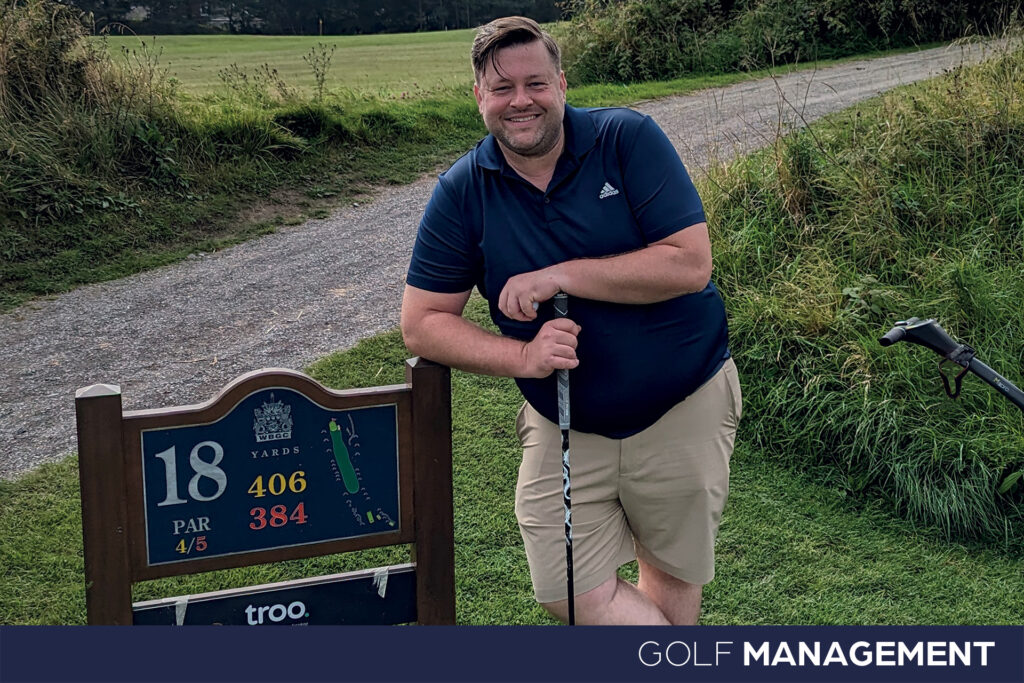

As account executive for energy broker Troo, Paul Davidson spends his days drilling down into a wealth of experience and knowledge to obtain the most beneficial utilities deals for his clients in terms of both suitability and cost.
What he also does for the golf clubs with whom he is involved is draw from a well of passion for the game that – unlike electricity, gas or water supplies – appears inexhaustible.
The 38-year-old’s love for golf springs from his days when his maternal grandfather first introduced him to the sport on driving ranges in Abu Dhabi where Eddie Batty contributed so much to the development of the Al Ghazal club that the first hole is named for him – Batty’s Burn.
He also has an uncle, Eddie’s son Kevin, who runs a golf holiday company, and his stepfather was a greenkeeper at Dundonald Links, Turnberry and Loch Lomond. Davidson joining Troo last year, to continue working in the energy sector while combining it with golf, appeared to be a move mapped out by family synergy.
“I’ve got a number of clients outside of golf that I’ve worked with for many years, but predominantly the majority of my new customers are golf clubs,” says Davidson.
“I developed a skill set within the energy sector to understand it in as fine a detail as I can. Then I thought, ‘let’s utilise these skills on something I love,’ and that’s how I’m where I am today.”
Troo offers a refined and forensic service that provides customers with a bespoke recommendation, enabling them to make an informed decision about which suppliers and contracts are best for them.
“We’re a consultancy or a broker, so that’s the foundations of where it’s at,” explains Aberdeen-born and Newcastle-bred Davidson, “but what is built on top of that is that everything is negotiated individually, managed correctly, and then obviously we advise on when to purchase, because you can buy your energy, if you wanted to, two years in advance.
“What I do is provide a bespoke budget review for the golf courses.
“Every club’s completely different. They’re not going to get options from all suppliers because of credit. A lot of clubs are sole traders, shall I say, rather than limited entities. It all depends on how much energy they use, which supplier is more favourable for the larger consumers, geography comes into it too, so there’s a lot of spinning wheels to get to a price.
“What I make sure I do is look at each supplier and then give the clubs all the information that they need. That will take me about a week to go through, where I know a club manager will not have that time,” emphasises Davidson.
“The majority of them acquire a substantial saving because a lot of the clubs will have just purchased the energy when they thought the time was right. They could have missed out if the purchase could have been made when (the price) was possibly better.
“Bi-monthly I will give them an update, refresh the pricing, send it to them and ask if they would be happy at this rate and this cost or do they want to gamble and try and play the market and see what they can get out of it. The decision essentially comes down to them. I’m just there to give them guidance.
“Even if they haven’t purchased any energy through us we’re still here to be account managers. If they’ve got any billing issues or any concerns, rather than staying on hold for 40 minutes or an hour, or what have you, they’ll just send it over to us with a couple of questions and we go and get the answers and come back and pop it in an email and we know it’s resolved. I’d say it’s another employee for the club.”
Davidson is very hands-on with his approach – well, hands, feet, arms. He visits clients to play the course, support events and get to know the membership.
“For me, you can email as much as you want, but I think understanding the character and the person behind the phone is key, especially in golf, as what I’ve learned since I was a young kid is it’s a community.
“Regardless of where you play, there is a community out there within golf where, I think, if you’re a golf person you talk business about five per cent of the time and the rest is talking about the club, and that’s what I’m keen on.
“The energy, I know where I am with that. I’m more interested in what’s the club like, what’s the membership numbers, what’s your plans for the future of the club, are you just going to be consistent at where you’re at?”
Because of his intense love for both golf and the supportive community environment it fosters, he gets dismayed when fellow golfers tell him rising annual subscriptions have created doubt about them renewing their membership.
This spurs him on to further efforts for his clients to ensure they make savings on their utility bills, helping provide more money both to keep down membership costs and invest in a club’s course and its facilities.
“If I had to decide that I was going to lose my membership because the cost of living’s increased, that would take us away from a community or a club that I’m part of,” he reflects. “If I can make one slight impact at any club so that members don’t feel they’re in that position, I think that’s a big win for me.”
“When I was growing up my grandad was always golf mad,” recollects Davidson fondly. “You would find golf balls and tees all over the place.
“We’d see him once or twice a year when we’d travel over to Abu Dhabi as kids and first thing I remember, going into the club was if I had my cap on, straight away he’d say, ‘Take your hat off. If you don’t take your hat off, it will get nailed to the bar.’
“And from then onwards it was ‘don’t walk over the putting lines’ etc… just course etiquette, you know?”
A par on only his second hole as a child prompted grandfather Eddie to make the quick assessment that Davidson was ‘a natural’, although two lost balls at the par-3 next led grandad to hasten him to the fourth hole ‘because I haven’t got enough golf balls in me bag’.
“I think me grandad and grandma, Kath, took the wrong brother out first,” he laughs while revealing brother Gary, a year younger, is a two-handicapper as opposed to his own level of 13. Both Paul’s fanaticism for and fascination with golf are, however, at tour level.
“There’s nothing I like better than shaking hands after you’ve played a round of golf. I remember that as a young kid,” he says, adding: “And it’s the community; you’re walking up one hole and there’s people walking down the other and you give them a wave, and it’s the jokes you have in the pro shop.
“You’re looking at clubs you know you shouldn’t be buying – how can you pay a few hundred for a driver that you can’t hit straight? – but you still do it, he laughs.
“Do you need blade irons if you’ve got a handicap of 24? No, you don’t, but it makes your bag look great.”
He has already introduced two-year-old daughter Rosie to his club, Bedlingtonshire (“it’s Bedlington, but the ‘shire’ makes it a bit more snazzy”), where all the lady members made a fuss of her.
“Every single one of them came up and asked her name and she was speaking to them. When we left she shouted, ‘Bye, ladies’ and they all shouted ‘Bye, Rosie’,” he enthuses.
“That’s why we go… the clubhouse is a home away from home, it’s just so welcoming.”