As adoption of autonomous mowing grows globally across golf, its value in giving skilled course management teams more time to improve the courses in their care is becoming increasingly clear.
For generations, mowing has been one of the defining activities of golf course maintenance. It is relentlessly repetitive and yet essential to the presentation and playability of any course. It is also enormously demanding of time, machinery and people.
That combination is prompting a growing number of golf venues to reassess how large areas of turf are maintained. Autonomous mowing is now being integrated into everyday operations across fairways, semi-rough, and increasingly complex areas of golf courses.
The shift is not simply about replacing one type of mower with another. It represents a broader change in how course managers allocate labour, schedule work, and balance presentation standards against financial and environmental pressures.
At the centre of the approach is a relatively simple principle: mowing little and often. Robotic mowers work regularly within digitally defined boundaries, with the result being they consistently remove small amounts of grass on each pass.
For the golfer, the most noticeable outcome may be greater consistency. For the greenkeeping team, the more important benefit is often the time released for work that cannot be automated. That distinction is crucial. Robotics are not a substitute for skilled greenkeepers.
Turf management remains highly specialised, shaped by agronomy, irrigation, plant health, machinery, construction, weather, and course conditions. Autonomous mowing can, however, take on some of the most repetitive work.
The experience of The Point at Polzeath in Cornwall offers a useful illustration of how that can work in practice.
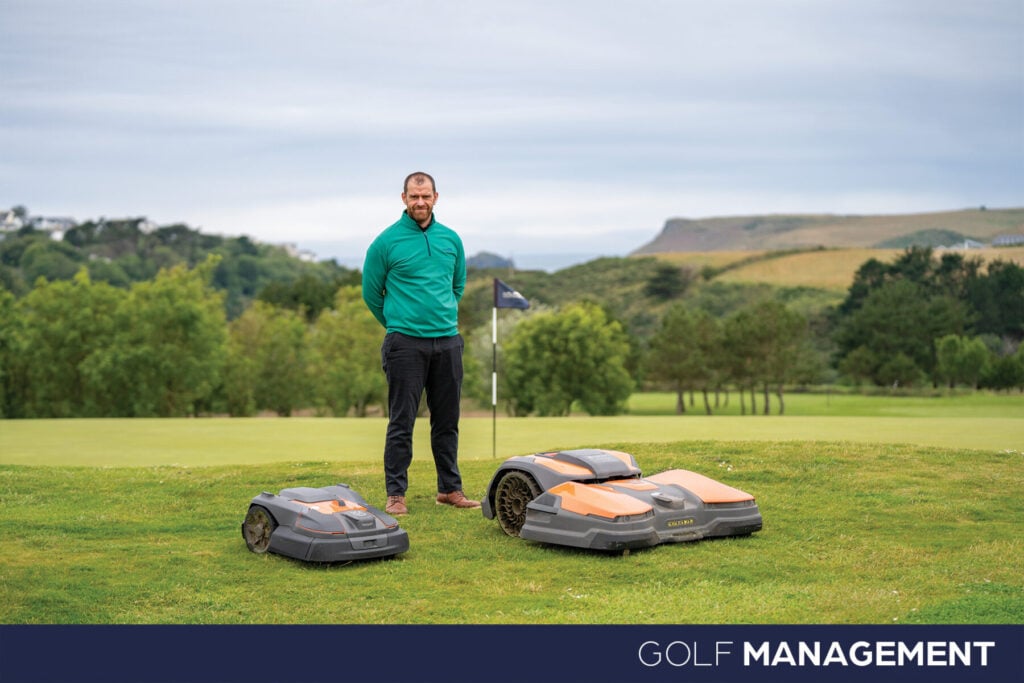
The objective was to produce a consistently strong golf course while operating with realistic staffing levels and managing the challenges of staff turnover. The Point has now had its full autonomous fleet operating for almost 12 months, using four Husqvarna CEORA mowers across larger, wider areas and several Automower 580 units on steeper, more undulating ground. The most telling results are not confined to how much grass the machines have cut.
“We’ve halved our fuel bill and we’ve halved our parts bill,” explains Head Greenkeeper Tom Collings (pictured). “Prices were going up so high that we were less able to do the things that actually improve the golf course. We were spending so much on simply maintaining a consistent level.”
At The Point, the answer has been a significant increase in agronomic work.
“In just a season, I’ve gained 500 hours of aerating, spraying and the cultural practices that I now have time to do,” says Collings. “That allows us to present the course to a high standard consistently throughout the year.”
Those 500 hours show where robotics may deliver most value. A machine can follow a mapped route and maintain a defined cutting height, but it cannot identify turf stress, manage moisture, repair wear, improve drainage, or choose the right cultural treatment. By taking routine mowing out of the daily workload, autonomous systems can give that expertise more room to make a difference.
There are also potential advantages in when and how maintenance takes place. Conventional mowing must usually be coordinated around tee sheets, competitions, weather, and daylight, often creating a narrow window in which teams can work.
Autonomous mowers can operate at quieter times, including overnight where conditions and site protocols permit. That can reduce interaction with golfers and allow surfaces to be freshly prepared by the time the greenkeepers arrive for work.
“You haven’t got a greenkeeper driving up and down on a loud mower,” Collings explains. “It’s now all done quietly, generally at night.”
At The Point, Collings has seen changes both in the turf and in the definition of the maintained areas.
“You get better definition and better turf consistently. The sward is much thicker, so it’s been a total game-changer,” he said.
Consistency is especially relevant during rapid growth, when a stretched team can quickly move from one urgent mowing task to the next. Once configured, robots can continue working to schedule while the team responds elsewhere.
They can also extend the practical mowing season. Lighter equipment may be able to work in conditions where taking a heavier machine onto the course would risk marking or compacting the ground.
“We can keep the robotic mowers working deeper into the winter and we can get them out quicker,” says Collings. “You could turn up on any day of the week now, at any time of year, and the course will be presented to a good standard throughout the 18 holes.”
No two golf courses present exactly the same maintenance challenge. Terrain, tree cover, bunkers, water features, narrow access points, and the way different playing areas connect all influence how an autonomous mowing programme should be designed.
That is why installation is not simply a matter of placing machines on the course. Husqvarna’s installation teams and Pro Partner dealer network work with greenkeepers to assess the venue, digitally map its characteristics, and create a bespoke cutting programme.
Virtual boundaries allow working areas to be defined precisely, while separate cutting heights and schedules can be assigned to fairways, semi-rough and other areas. Stay-out zones and transport paths can also be incorporated, helping machines move safely around bunkers, water features, trees, and course infrastructure.
The programme can then be refined as the team gains experience or requirements change. Cutting schedules can be adjusted around weather, competitions, and periods of increased growth, while digital boundaries can be updated to reflect alterations to fairway shapes or the wider course layout.
This tailored approach means autonomy can be integrated into the existing maintenance strategy rather than forcing the venue to reorganise around the technology.
The greenkeeping team retains control over how, when, and where mowing takes place, supported by specialist installation expertise.
The most effective installations are collaborative, combining the greenkeeping team’s knowledge with technical expertise to create a system suited to the course, its standards, and its ambitions.
Yet the wider story is less about any individual machine than the changing role of course maintenance technology.
The value of robotics should not be measured only in acres cut or litres of fuel avoided. It should also be assessed through improvements made possible elsewhere: more aeration, better irrigation management, attention to bunkers and course furniture, and more time spent improving the turf.
For The Point, the result has been a course that can be maintained more consistently without asking skilled employees to spend much of their working day completing repetitive mowing or keeping conventional machines running.
That may be the most persuasive argument for autonomy. Greenkeepers remain central to every successful golf course, but their time is finite. If technology carries more of the routine workload, that time can be invested where their expertise creates greatest value.