You’re trudging off the ninth green after your putt has horseshoed, you’ve had a mare of a front nine but suddenly, you find yourself breaking into a trot at that unmistakeable smell of sizzling bacon.
The halfway hut is a luxury many golf clubs simply don’t have. Whether you’re gasping for a cold beer in the heat of the summer or attempting to regain some feeling in your fingers with a hot coffee on that wintry day, golfers are a thirsty and hungry bunch.
And now for those clubs which don’t normally offer such facilities, thanks to some Horse Box Hospitality, there’s a chance to start that back-nine fightback with a gallop.
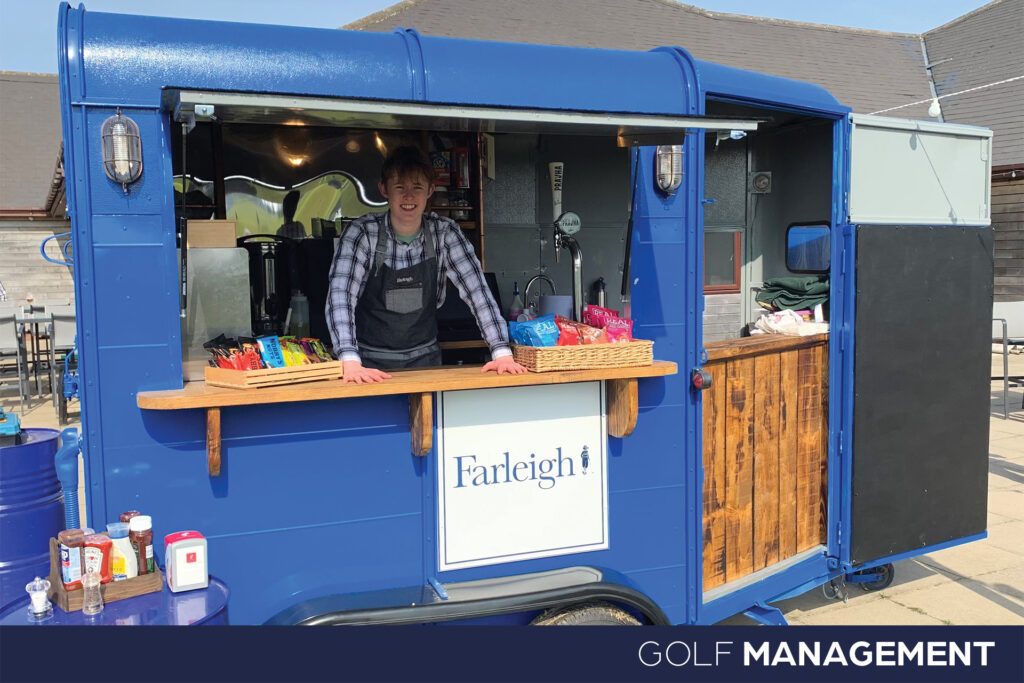
The brainchild of golf professional, Steve Salter – formerly associated with London Golf Club and Bearwood Lakes – the idea is one of those simple solutions. In fact, it begs the question of why all clubs without a halfway hut wouldn’t saddle up for a slice of extra revenue and an additional service for its members and guests.
Salter explained: “I’ve always had this thought that golf clubs which don’t have a halfway hut are missing a trick. It’s an extra revenue stream and an added service for members and visitors.
“It can sometimes be a little bit difficult for golf clubs to get planning permission on their land, but these horse boxes are on wheels so don’t need it.
“So when these horse boxes started coming on to the scene where people had converted them for coffee shops or somewhere to get a snack in street markets, I thought: ‘these would be absolutely ideal for a golf club’.
“When the pandemic came around and hospitality shut down, golf clubs were allowed to let people on to the course, but they weren’t allowed in the clubhouse.
“So clubs had to find a way to serve customers outside and I thought it was the right time to give it a go. I bought a couple of horse boxes and the first two clubs I spoke to were keen – so I thought I might be on to something.”
As many golf club members know, the wheels can turn slowly when it comes to making positive decisions and spending money.
But it needn’t be the case. The beauty of the converted horse box is the versatility and mobility without either a huge financial outlay or the perceived cash risk to a club which is already up against extensive financial pressures.
Salter said: “They can either be rented or purchased outright.
“We have five horse boxes that we rent out – usually for a minimum of six months. If a club rents it for a couple of seasons either side of the summer, they get a good idea if it’s going to work for them.
“The rental option is £400-£700 per month. Or to purchase, it’s about £13,500 – depending on the catering equipment required.
“Verulam Golf Club in St Albans took a rental horse box and I got a phone call from the manager two months later telling me to come and pick it up. I thought ‘Oh no, what’s gone on here?’
“But he was asking me to pick it up because he wanted to buy one. Within those two months he knew it was a great addition.
“It’s actually not a huge commitment – you’re talking about maybe £3,000 for a six-month trial period, which is between £100-£150 per week. If a club doesn’t make that money back in that time, they are doing something wrong.”
In terms of the actual horse box – they genuinely have had horses in them at some point and may even retain some of their original battle scars from the odd stray hoof – they are then kitted out in less than five weeks at the workshop in Leicester.
All boxes come with hot and cold hand-washing facilities as standard and the club’s specifications are then added with a portable gas supply and griddle for cooking hot food, warming cabinets and even a beer pump or two, if required.
Fridges and freezers can either be powered out on the course through an electricity supply or the horse theme can be extended to suppress any unwanted generator noise if a power supply isn’t readily available.
Salter said: “Typically, golf clubs have some power around the course where they can tap into it.
“If that’s not possible, you have the option of a generator but that buzz of the generator never goes that well on a golf course. Some have got around that by sinking it into the ground, sticking a couple of hay bales on it and you can’t hear it.
“The future is something called a power station. It’s a rechargeable lithium battery about the size of a briefcase, which you bring back to the clubhouse and power up by the mains. It then has enough power to keep the fridges running for the next day.
“But we always sit down with the clubs and work out what they want to provide for customers.
“Usually, it’s a griddle for bacon and some of those warming cabinets for sausage rolls and pasties, an urn or coffee machine and a fridge or two.
“We put their club logo on it and all of the equipment in, so it turns up, they plug it in and they are ready to go.”
Aside from the obvious appeal to thirsty golfers, there’s an additional benefit for a club looking to maximise its revenue opportunities or simply improve the experience for members and visitors.
Salter said: “It’s mobile so it doesn’t have to stay in the same place all the time. Clubs can put it wherever they like or an area where a couple of holes might cross so you can catch people twice.
“If there is a wedding, event, the Pro-Am or Captain’s Day, they can use it as an extra bar or roll it out for summer evenings.
“Some clubs have also been able to effectively hire it out to companies who might be sponsoring an event at their club. Add the company logo and it becomes that company’s horse box for the day out on the course,” Slater said.
“Even if the club doesn’t want the hassle of staffing it or stocking it, there are people who would probably love that opportunity for so many customers to walk past them every Saturday or Sunday or those busy midweek days.
“So even if the club decides to “sell” the pitch and isn’t looking to make a huge profit from it, they are adding a great extra service to members and guests.”
While in Europe or USA, it’s part of the golfing culture to stop for refreshments, the race to get round can sometimes be the pressing priority for UK golfers.
But Salter believes even those clubs with members less keen to stop for a drink and a snack will find regular customers who will welcome their new portable café with open arms.
He said: “I play golf six times per year these days in a society. They still make me play off scratch and I can shoot anywhere from 67 to 90.
“But none of my mates or fellow society members would ever go on a golf course and not stop at a halfway hut if there is one. It’s a bacon sandwich and a hot cup of coffee when it’s cold and perhaps more importantly to some of them, it’s a chance for a cold beer when you’re a couple of hours away from the clubhouse.”