
There’s an adage that states: originality is simply a pair of fresh eyes. And the appointment of Mark Darbon, as chief executive of The R&A certainly brings fresh eyes.
Until he took up the post in late 2024, 45-year-old Darbon had never worked in golf. But, if any traditionalists out there are starting to get their tweeds in a tangle, he’s certainly not one for ‘throwing the baby out with the bath water’.
Fresh from guiding rugby union’s Northampton Saints to their first Gallagher Premiership title in ten years – in a near eight-year tenure as CEO – Darbon swapped Northampton for St Andrews.
He explained: “If you look at the typical tenure for a CEO in an elite sport club, I’d been at Saints longer than average. But I was really enjoying it, and we were making good progress on and off the pitch.
“I certainly wasn’t actively looking, but this was the type of opportunity that, when you hear about it, is very hard to look beyond. I was excited as soon as I got the call from the recruitment firm the R&A used.”
It was no surprise the agency had Darbon on speed-dial. His record in sport is impressive, entering the sector in 2009, when he left drinks giant Diageo, to, ultimately, occupy the position of head of Olympic Park operations for the 2012 London Olympics.
Following the resounding success of the event, he served as an advisor to the International Olympic Committee, from 2013 to 2018, while holding down full-time roles elsewhere. He joined Tough Mudder Americas, in New York, as senior VP for two years, before climbing into the saddle as CEO at cycling promoter Madison Sports Group, for another two-year stint.
The Saints came calling in 2017 and he introduced a commercial strategy which turned the club around and achieved record revenues in consecutive seasons.
The Oxford University alumnus also remains a non-executive director of Northampton Saints and England Hockey. Fresh eyes, indeed.
He said: “I believe, through my career, I’ve developed a skillset well suited to the brief at the R&A. I’ve done a lot on the commercial side of sports. Clearly, we need ensure to ensure the Open Championship is at the pinnacle of our sport – it’s much more than just one of golf’s Majors. It’s one of the global sporting events that really matters.
“I’ve been involved – through the Olympics and other events – in staging big global events, so I understand the operational side of those propositions and what goes into making them as seamless as possible. That’s a big part of what we do on the biggest stage with the Open and the AIG Women’s Open, but also through other events we’re staging around the world.”
Those skills will also be required to address the fractured relationships within the professional game and the consistently thorny issue of participation, particularly encouraging and retaining younger golfers.
And he’s already started with the recent announcement of a new category to enable players competing in LIV Golf to earn a place in The Open.
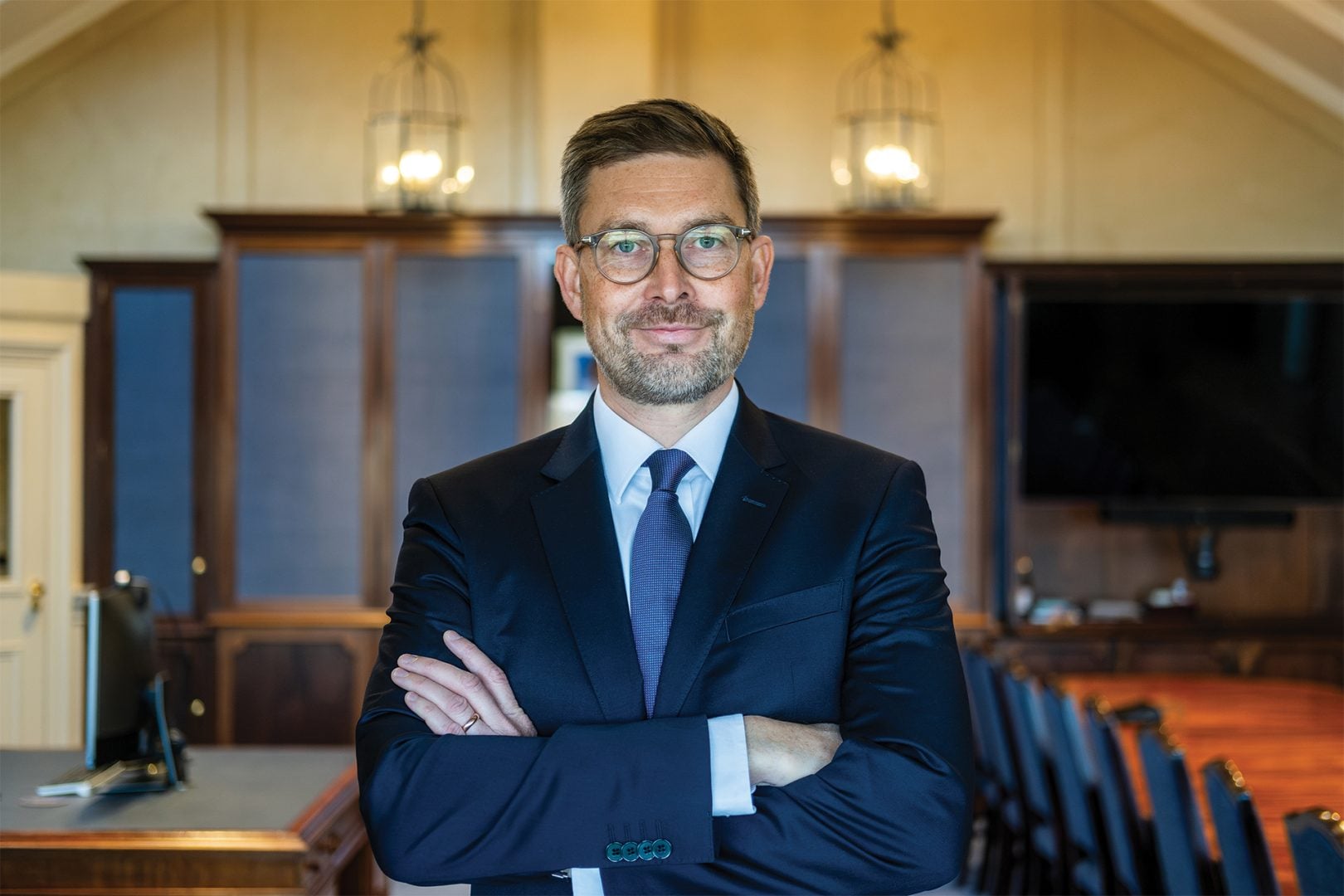
Darbon said: “I’ve done quite a lot in terms of stakeholder relations and one of the things that has struck me about golf is quite how fragmented the sport is. I used to think rugby was quite fragmented, but at all levels – international, regional, national – golf is extremely fragmented. So, the ability to build the right relationships, and manage some of those stakeholders effectively is important.
“If you think about our remit and how that matters to young people, there’s a good few things we can do. The first pillar, here at the R&A, is inspiration. I’m a big believer that there are very few sports that really thrive from a participation perspective, unless the shop window – the very top of the game – is strong.
“And I think it’s undeniable the shop window in golf has not been as strong, recently, as it could be. So, I’m eager for us to work with the stakeholders around the game to try to evolve that. But there’s lots more we can do below that, because the second pillar, then, is all around participation.
“One of our responsibilities is to break down barriers to participation, particularly for young people. The trend in participation around the world has been positive. Basically, in the territories we orchestrate, there are more than 60 million people playing the game of golf.
“Roughly a third of those are not playing every week, but they’re engaging in the sport in other ways, and we should be proud of the work we’ve done in that space. At the same time, I find it concerning that in a list of sports, ranked by engagement, golf does not feature in the top 30 for Gen Z adults.
“We’ve got some work to do around how we break down barriers for young people to get them into the sport and then, importantly, keep them. And that’s not a new challenge. Rugby, tennis, and cricket – to some extent – have the same challenge, and we’re all competing in a marketplace where young people have lots of things they can be doing.”
One activity young people have traditionally participated in during the last 70-odd years is watching live sport on TV – originally on terrestrial TV. How many of us became engaged with – and inspired by – golf, for example, by watching the exploits of Nicklaus, Palmer, Faldo, Ballesteros, and Woods?
And, the recent news that LIV Golf will be available, in 2025, to watch in the UK on free-to-air ITV, might add to the clamour to see the Open return to terrestrial TV.
Perhaps, unsurprisingly, given his sharp commercial mind, Darbon is not committing the R&A to the Open’s return to the BBC. Darbon explained: “If you look at the UK, we’re really proud of the coverage we have with Sky and I believe there are as many people watching the Open now as when we first took the proposition behind the paywall.
“I don’t think it’s as simple, necessarily, as terrestrial TV equals more engagement. At the same time, it’s our responsibility to ensure all elements of our Open content are appealing to the different audiences they serve.
“It’s a fact that lots of young people are not sitting down and watching four-hour long broadcasts of a final round,” he admits.
“So, one of our key questions is how do we package up other aspects of our content, serve that appropriately through different channels, to capture the hearts and minds of different aspects of our audiences, and then, on the back of that, run programmes that capture that excitement, that inspiration, and enable us to drag people into the game?
“I think there’s lots we do effectively already, but there are some opportunities for us to do more on that front.”
Marketing gurus like to use the descriptor ‘disruptive’ for somebody who uses innovative and unexpected ways to stand out from competitors, and the term has been used to describe Darbon. But, like a tightrope walker heading from tee to green at the 16th on Vale do Lobo’s Royal Course, the three handicapper realises balance is essential.
He added: “One of the things I’m really excited about is how do we continue to preserve the wonderful history and heritage our sport – and the R&A – has, while also being innovative, proactive, and on the front foot, to ensure the sport is in a better place for future generations.
“At Northampton Saints, we used to talk a lot about the history and heritage of the club while also saying we were one of the most innovative clubs out there. I’m excited by how you use history and heritage to help you be progressive for the future.
“I don’t see those things as being in competition because our rich history and heritage gives us such a strong platform from which to operate. It validates a lot of our activity around the world, and that’s exciting.”