
Few careers in golf management follow a straight line. For Ryan O’Connor, now general manager of Woodsome Hall Golf Club in Huddersfield, his path has been defined by opportunity, hard lessons, unexpected detours, and a deepening appreciation of what shapes a golf club’s identity.
His story is intertwined with the extraordinary heritage of Woodsome Hall, home to what may be the oldest golf clubhouse in the world.
O’Connor’s journey began not in a boardroom but on the turf itself. Growing up just 150 yards from a golf course, he discovered the game early. “I played golf from the age of 13,” he recalls, adding with a laugh, “I could bizarrely play both left handed and right handed.”
By his teens he was junior captain, but like many young people he reached a crossroads after school, unsure of his next step – until a friend mentioned a golf management course.
A place on the programme at Myerscough College opened the door to Marriott Golf, where he began his career in 2001. What followed was a grounding in the nuts and bolts of golf operations: “Picking up golf balls, washing buggies, all that sort of stuff,” he says, before eventually earning a posting at Marriott’s Sprowston Manor in Norwich.
Marriott provided not only experience but mentorship. He speaks appreciatively of key figures: “I was surrounded by people who have gone on to really big things in the golf industry,” he says, referencing influences such as David MacLaren, Stephen Follett and Jason O’Malley.
These early years instilled the hospitality ethos he still carries today.
In 2008, at just 27 years old, O’Connor made the transition from a corporate environment to a traditional private members’ club, accepting the role of general manager at Royal Norwich. “At the time, I was chasing my career,” he admits. “The opportunity to be a GM was just too much to turn down.
“When I became GM at Royal Norwich, I was still quite young,” O’Connor recalls. “Now 27 these days isn’t young, but back then it was. I remember attending GCMA meetings at the time, and I was by far the youngest person in the room.”
The shift was jarring. Applying Marriott style systems to a member led club proved ineffective, which perhaps explains why O’Connor initially didn’t think he would be the ideal candidate for the position.
“A previous colleague of mine called me to ask if I had applied for the role, to which I replied ‘they don’t want somebody like me… I’m 27 with a corporate background.’
“He then said that Royal Norwich had contacted him to get my number and that I was what they were looking for.”
But, in hindsight, O’Connor’s gut feeling was proved correct, and the club’s looming relocation added pressure, with aging infrastructure and limited investment making day to day management challenging.
“For the first six months… it was just not sticking. It was not going to work,” he says. “I was a real rabbit in the headlights.”
Yet the experience toughened him. He managed member expectations during uncertain years and learned to navigate the culture of private golf clubs – insight that would serve him throughout his career.
After three years at Royal Norwich, personal circumstances drew O’Connor to a brief tenure at Halesworth Golf Club, before a return north followed, leading him to Woodsome Hall for the first time in 2014.
But within ten months he left for family reasons – a decision he now calls “the biggest regret” of his career.
“At the time I had family pressures, including parents who were ill and a relationship which broke down three months after the move,” he shares openly. “I literally burnt myself out… working 70, 80 hours a week.”
Planning to step away from the industry entirely, he found unexpected renewal at Nelson Golf Club, a smaller operation that restored his energy and love for club life. That paved the way to Stockport Golf Club, where he became their first general manager, helping modernise operations and making what he describes as “bold decisions” to drive the club forward.
A turning point came when he moved into the software side of the industry with Club Systems and ClubV1 in November 2022. Although a departure from club life, the role broadened his understanding of how deeply technology underpins modern golf operations.
“I found it really eye opening,” he says. “As a GM, you think it’s a click of the fingers. It is so complex.”
The experience gave him empathy for both managers and developers, strengthening his expertise in digital infrastructure – knowledge now essential as clubs transition to integrated platforms.
However, just over a year later, when the manager at Woodsome Hall announced his planned departure, O’Connor returned to advise the club – only to find himself unexpectedly being courted for the role again.
“Two hours later, I was agreeing to a coffee with the captain, and I came back,” he says. “It was like the stars were aligned.”
The welcome was overwhelming. “Lots of members were so pleased to see me back,” he says, reflecting on the importance of his earlier tenure, even though it lasted only ten months. He had, during that short period, led the pivotal proposal for the club’s Dormy House accommodation – now renamed the Cottage on the Course, achieving an 83 per cent member approval vote – a legacy that left a lasting imprint on the club’s development.
Now two years into his second spell, O’Connor is committed for the long term. “I have no intention of leaving again,” he says with conviction. And to understand O’Connor’s deep connection to Woodsome Hall, one must appreciate the extraordinary setting in which he works.
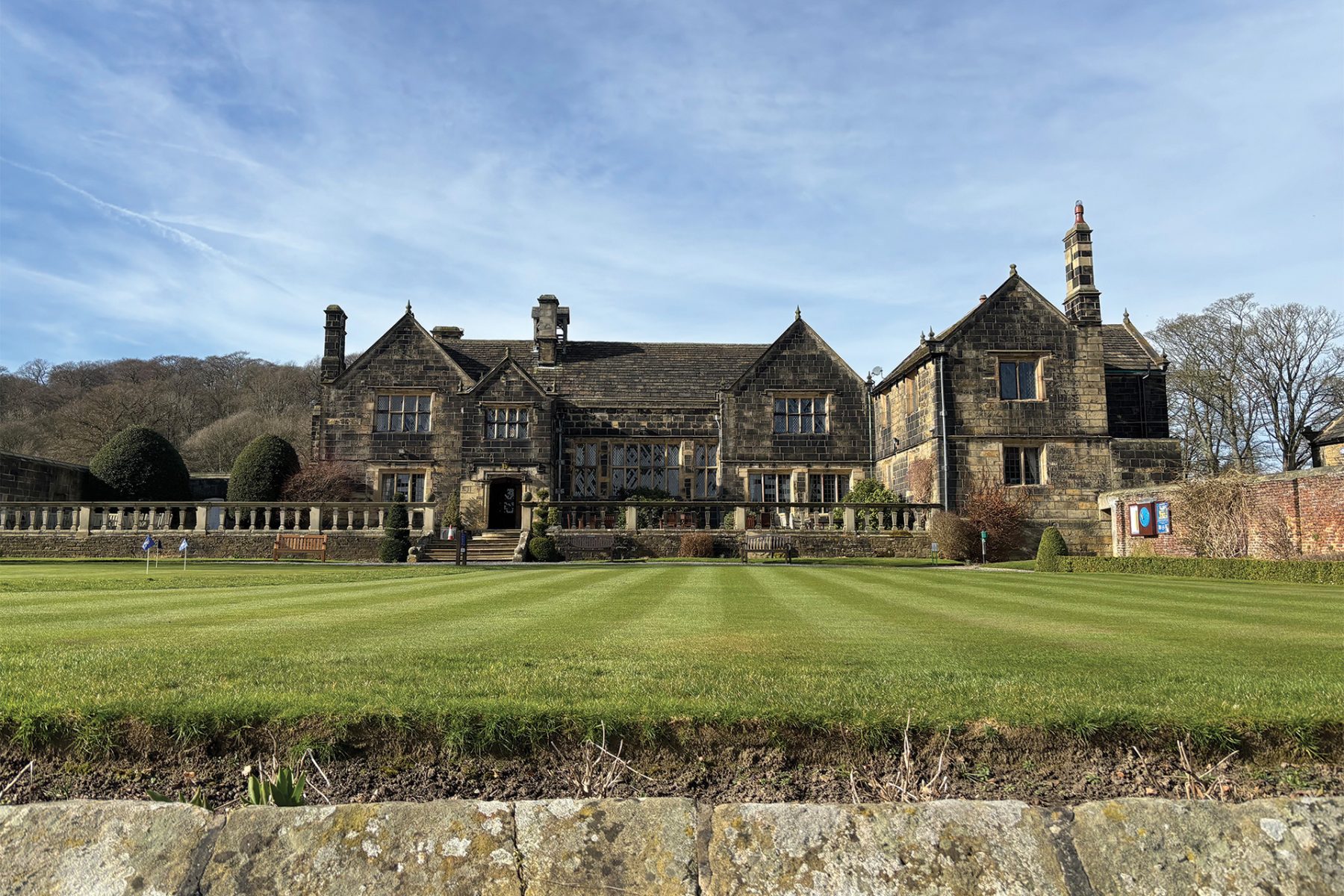
The clubhouse at Woodsome Hall is no ordinary building. Constructed in 1462, it is believed to be the oldest golf clubhouse in the UK, and potentially the oldest in the world. This medieval manor, with its stone archways, historic timbering, and atmospheric rooms, provides a sense of place that few modern clubs can match.
As O’Connor notes: “Our beauty is our challenge.” The Grade I listed status protects its historic character but imposes strict limitations.
“You literally have to consult the documents to see if you can put a pin in the wall,” he says. The main function room can host only 62 people, and the bar and kitchen are on opposite sides of the building – an operational quirk unimaginable in a contemporary clubhouse.
Yet the building’s charm is undeniable. “It still takes my breath away every time I drive up the driveway,” he admits.
This heritage is not just a backdrop but a marketing asset. “We’ve got history here that you just don’t find in America,” he explains. Its international appeal – particularly to US visitors – is a strategic focus for the club as it seeks to raise its national and global profile.
Still only 45, O’Connor’s vision for Woodsome Hall balances respect for its history with the practical demands of a modern membership club. Investing in the golf course – originally designed by Harry Colt and later updated by James Braid – is a priority, with significant drainage projects already under way, plus a semi permanent function room is under exploration.
“Woodsome is the type of club where it doesn’t need dramatic change,” he says, adding “we are focusing on cash generation and we’re investing in the club and giving ourselves stability moving forward.
“We have so much history here, and we even do history tours of the hall which is a Grade I listed building,” he concludes.